Roads that think.
Speeds that adapt.
Congestion that clears itself.
A decentralised cyber-physical system that puts a real-time, privacy-preserving compliance speed in every vehicle — clearing congestion and preventing crashes at choke points before they happen.
Indian roads are deadly and clogged — because traffic control is static and blind.
Signals run on fixed timers. Speed limits are painted on signs. Enforcement reacts after the crash. None of it adapts to what is actually happening on the road, second to second.
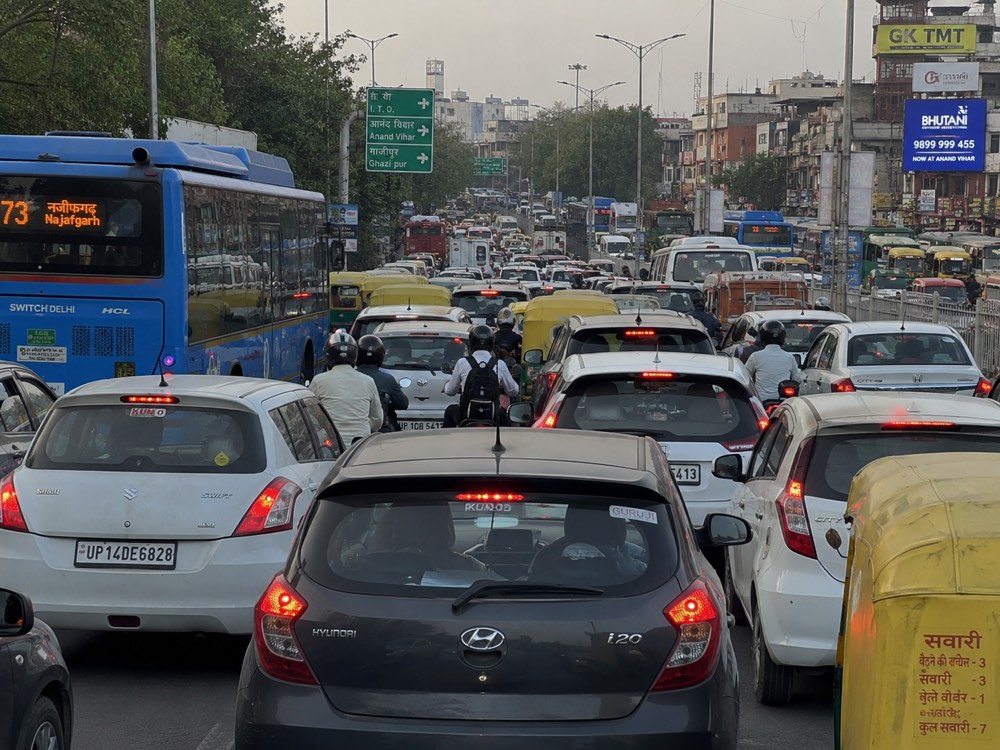
This jam isn’t random — it’s every vehicle reaching the same point at the same moment, with nothing telling them to arrive a few seconds apart.
lives lost on Indian roads every single year
yearly congestion cost to just four metros
of road deaths occur on highways — just 2% of roads
Bengaluru ranks among the world’s most congested cities
Sources: NCRB road-fatality data · Indian metro congestion-cost studies · IIT Delhi highway-safety analysis · TomTom Traffic Index.
Reactive, centralised, and expensive to run
Fixed signal timing
Lights cycle on pre-set timers that ignore live density — green for an empty lane, red for a packed one.
Static speed limits
One painted number for every condition. Drivers have no way to time their approach to a junction.
Capex-heavy enforcement
Every junction needs cameras, signals, sensors and staff — capital-heavy, centralised, and still only reacting after the fact.
Every vehicle is told the right speed, right now.
Valenceware computes a personalised compliance speed for each connected vehicle so they never reach a choke point at the same moment — making every plying vehicle responsible for its own compliance.
Compliance-speed calculation
A per-vehicle recommended speed, derived live from density, trajectory, choke-point proximity, weather and the vehicles ahead.
Free-flow zone identification
The system detects where speed control isn’t needed and signals an open road — drivers only slow when it matters.
Violation detection
Live speed is checked against the compliance speed within a dynamic tolerance; only breaches are recorded — vehicle, not driver.
The right speed, shown on the dashboard.
A low-cost in-cabin device turns every vehicle into its own enforcement node — displaying a live compliance speed and easing the approach to junctions before the jam forms.
Open road · drive your limit
Compliance speed, on the glass
The mounted unit shows the exact speed to hold right now — not a static painted limit.
Free-flow when it’s clear
Open road is signalled instantly; the driver only eases off when a choke point is actually ahead.
Computed at the edge
GPS + GSM + CPU on a lightweight Unix OS — the decision is made inside the cabin, in real time.
A living mesh — vehicles, edge nodes and the cloud, talking in real time
Each vehicle broadcasts to nearby edge nodes and to the vehicles around it. Only outcomes — violations and scores — travel up to the cloud learning engine, which streams sharpened compliance speeds back across the whole network.
An edge-first cyber-physical control loop
Movement data is processed on the device. Only outcomes — confirmed violations and driving scores — ever reach the cloud, where a learning engine sharpens the speed model and feeds it straight back.
In-vehicle IoT device
GPS, GSM, CPU & display on a lightweight Unix OS — captures location/speed, shows the compliance speed.
Edge processing
Raw movement data is computed locally and never uploaded — cutting latency, bandwidth and privacy risk.
Cloud learning engine
Receives only violations and scores; reinforcement learning tunes compliance speeds to live patterns.
Closed-loop feedback
Updated speeds stream back to each device; the model keeps learning across the whole network.
Intelligence moves into the vehicle — not the roadside.
Traffic control today is centralised and capital-heavy. Valenceware flips it: the decision lives in a low-cost device inside each vehicle — turning every car into its own enforcement node.
- Cameras, signals, gantries and control rooms at every junction
- Capex scales with each new intersection
- Staff-dependent and still only reactive
- One low-cost device per vehicle makes the decision at the edge
- Each plying vehicle is responsible for its own compliance
- Coverage scales with vehicles, not city budgets — and pre-empts the jam
We track the vehicle — never the person.
Privacy isn’t a setting bolted on later; it’s the architecture. Personal movement never leaves the vehicle.
Edge-processed
Driving data is computed on the in-vehicle device — raw movement history is never uploaded or stored in the cloud.
Vehicle, not identity
Records attach to the vehicle, like a service log — not to where the owner went or when.
mParivahan-ready
Designed to map violations and scores to the national VAHAN / mParivahan registry without exposing trip data.
Road Excellence Score
A per-vehicle driving-quality metric — think of it as a credit score for road behaviour.
The only behavioural output that leaves the edge — violations and the score, nothing else.
One system, every vehicle on the road
Vehicle-agnostic from day one — and built to carry into the autonomous era.
Two-wheelers
India’s largest vehicle class
Cars & SUVs
private & commercial
Trucks & buses
heavy and public transport
Electric vehicles
EV-ready out of the box
Legacy vehicles
retrofit older, in-use vehicles
Autonomous (future)
V2X-ready for self-driving
The method is granted and protected.
Valenceware holds an Indian patent on the complete dynamic AIoT traffic-management system and its operating method — granted by the Patent Office, Government of India, establishing priority over the core mechanism.
“System and Method for IoT-Based Real-Time Traffic Management” — granted to Valenceware Services Private Limited.
- Patent No.
- 589371
- Application No.
- 202311075610
- Date of grant
- 14 May 2026
- Term
- 20 years from 06 Nov 2023
 View official certificate (PDF)
What the grant covers
- 01
Per-vehicle compliance speed — live, individualised target speed per connected vehicle.
- 02
Dynamic violation tolerance — flexes with choke-point spacing, vehicle count & safety margin.
- 03
Free-flow zone detection — automatic identification and display of unrestricted zones.
- 04
Edge-first, learning system — local processing with reinforcement learning over the network.
- 05
Vehicle-anchored records — decentralised, privacy-preserving compliance logging.
Roads that think — a technology we’re building now.
A decentralised, privacy-first compliance-speed system for Indian roads — designed, patented, and actively under development.
Edge-first
Decisions computed inside the vehicle, in real time.
Privacy by design
We track the vehicle, never the person.
Patented
Indian Patent No. 589371 — granted.
Vehicle-agnostic
Every vehicle class, V2X-ready for the autonomous era.
Want to know more about the technology?
Reach out to the Valenceware team.
© 2026 Valenceware Services Pvt. Ltd.
CIN U22219JK2022PTC013197 · Poonch, Jammu & Kashmir